The park, honestly explained — then the right tour to see it.
An independent guide to Ang Thong National Park: what the 42 islands actually offer, what's closed and when, and how the group, speedboat, sailing, private and cruise-guest tours from Koh Samui really differ. Not the official park website — a guide and booking comparison from a licensed local operator.
✓Live prices from the shop. What you see at checkout is what today's rate actually is, not a stale number.
✓Licensed tour operator. Koh Samui Advisor Co., Ltd., TAT licence no. 44/00295.
✓Honest about closures and weather. Including the annual monsoon closure and what happens if a sailing gets cancelled.
✓Booked directly with the operator. On kohsamui.tours, no reseller markup in between.
Plan ahead: the park is closed from 1 November to 15 December 2026 and can close at short notice in rough weather. Season & closures
All Ang Thong tours from Koh Samui
Which Ang Thong tour suits you?
Big boat
The classic economy option: a larger ship, a set group itinerary, breakfast and lunch on board. Steadier in a swell than a speedboat, with more time on the crossing and less at each stop. The easiest choice if seasickness worries you.
Speedboat
Faster out and back, so more time actually on the islands. Some speedboat departures run semi-private with a capped group size and an earlier start, reaching the viewpoint before the crowds. Rougher ride in a swell than a big boat.
Sailing boat
A wooden sailing ship instead of an engine-first crossing, running only on fixed weekdays. Slower, roomier, and the trip back is timed for sunset. One listing markets the same sailing as a filming location for HBO's The White Lotus — same boat, same itinerary, different pitch.
Private
Your own boat, your own pace — climb the viewpoint or skip it, linger at the lagoon or move on. Costs more per person in a small group, but nobody else's schedule decides your day.
Cruise guests
Built around the tender schedule at Nathon pier instead of a hotel pickup. Group and private versions exist; read the cruise page here before booking, since the return-to-ship guarantee works differently for this particular excursion.
What happens next. Your travel date and group size are requested in the shop — that's also where you see availability and the final price. Booking and payment take place on kohsamui.tours, run by Koh Samui Advisor Co., Ltd. This page is an independent guide and booking comparison, not the official website of Mu Ko Ang Thong National Park or Thailand's Department of National Parks (DNP).
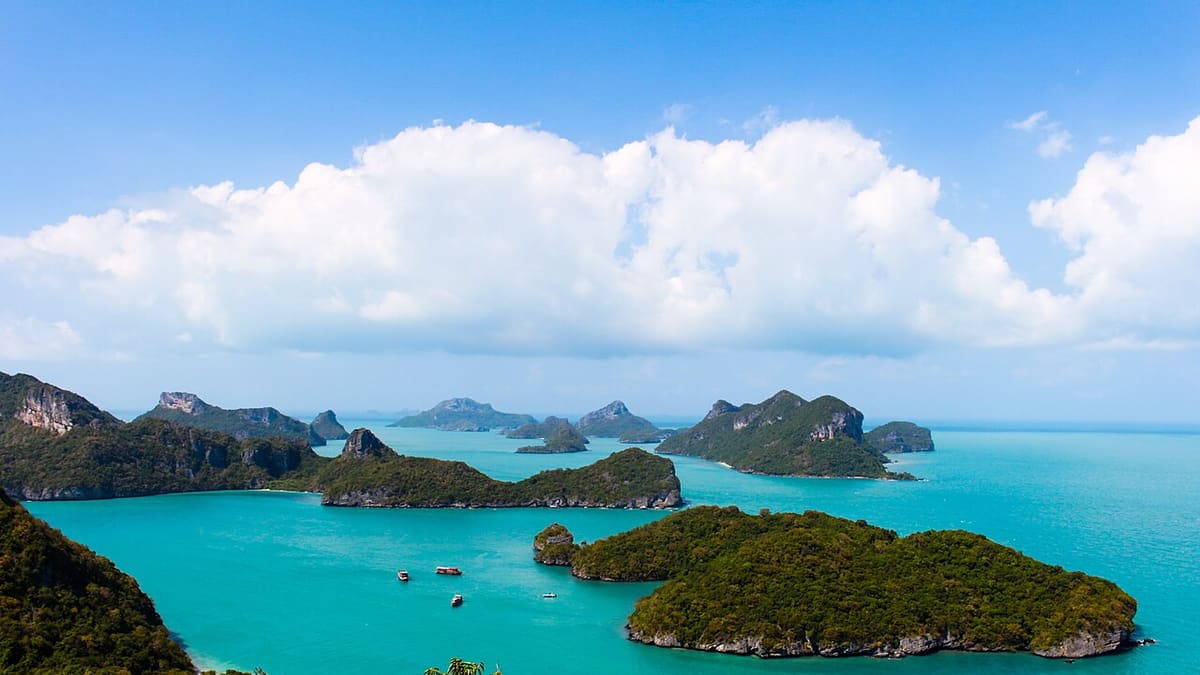
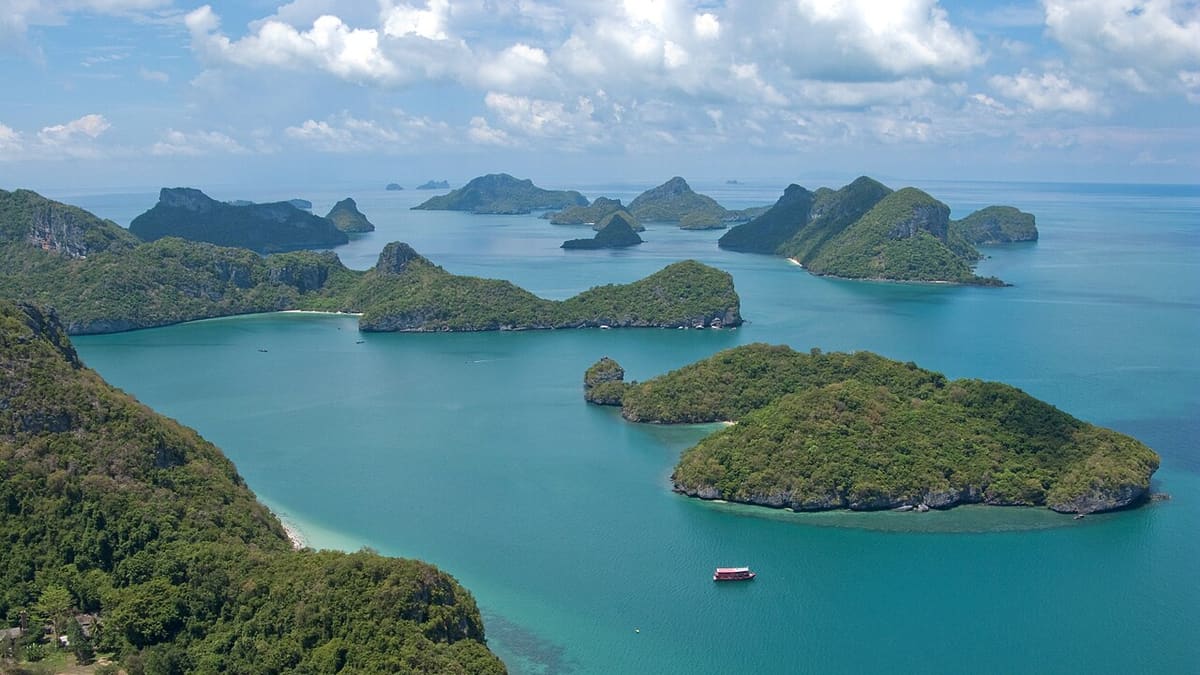
Forty-two islands over roughly 102 square kilometres — most of it sea, not land. Photo: Ditsakul, CC BY-SA 3.0
Mu Ko Ang Thong at a glance
A marine national park of limestone islands off Koh Samui's west coast — and why "golden bowl" is the name to know.
Islands
42
Total area
≈102 km²
Land area
≈18 km²
Established
12 Nov 1980
What "Ang Thong" means
Mu Ko Ang Thong translates roughly as "archipelago of the golden bowl" or "golden basin" — most tour operators shorten it to Golden Basin. The name refers to the shape the islands trace on the water, not to any specific landmark. The park sits in the Gulf of Thailand, roughly 30 to 35 kilometres northwest of Koh Samui, and has been under official protection since 12 November 1980 — one of the older marine parks in the country.
Of the park's total area of around 102 square kilometres, only about 18 square kilometres is land; the rest is the sea and reef between the islands. That ratio matters for a visit: almost everything you experience here happens either on a boat or on a handful of the larger islands, not by wandering freely between them.
No resorts, no villages
Unlike Koh Samui or Koh Phangan, there's no tourism infrastructure spread across the islands. The only permanent settlement is the small Department of National Parks (DNP) station on Koh Wua Talab, which handles park administration, a restaurant, a shop and the overnight bungalows and camping ground. Everyone else — day-trippers on a tour boat, campers with a booking — comes and goes by sea.
This page is an independent guide written by a licensed Koh Samui tour operator, not the park authority. For anything official — permits, park regulations, current closures — the Department of National Parks (DNP) Thailand is the primary source, and we link to it where it matters.
Correct as of September 2026. Sources: DNP, Tourism Authority of Thailand (TAT).
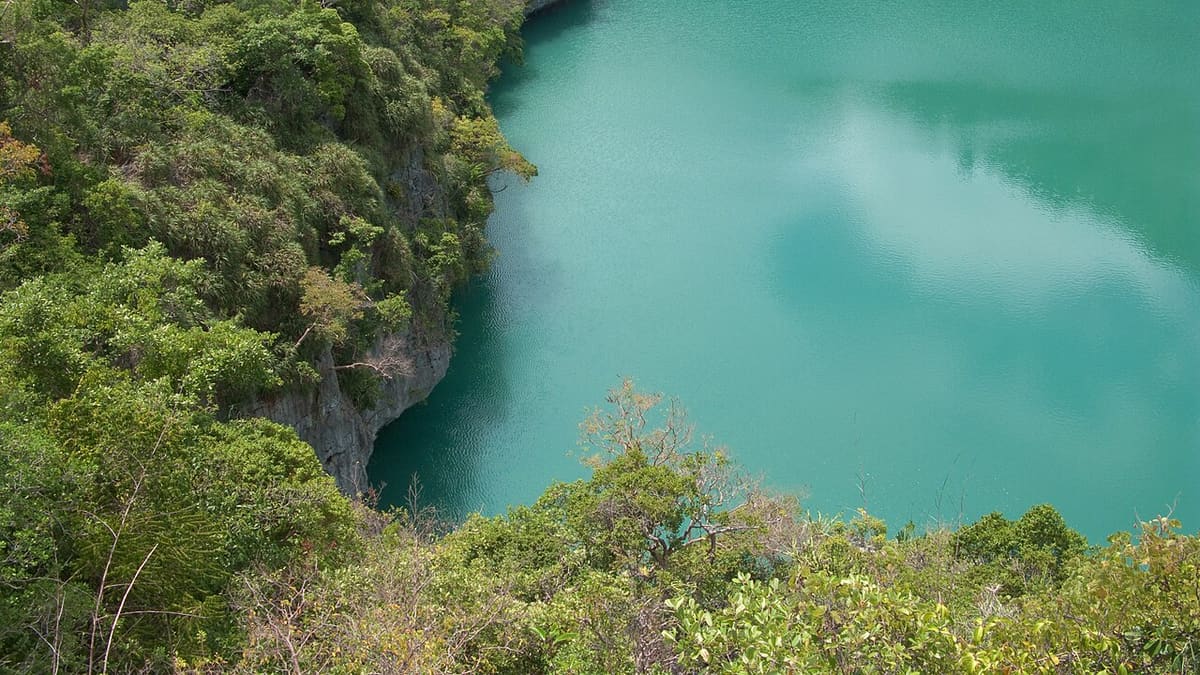
Talay Nai, the Emerald Lake on Ko Mae Ko, seen from above. You look at it from the viewing platform; swimming is not allowed. Photo: Vyacheslav Argenberg, CC BY 4.0
What's actually worth seeing
The lagoon, the viewpoint, the beach — and what to expect honestly from snorkelling here.
The Emerald Lake (Talay Nai) on Koh Mae Ko
A saltwater lake sits inside the island of Koh Mae Ko, connected to the sea by an underground channel and often shown on brochures as the park's signature image, in shades from deep green to turquoise depending on the light. A wooden walkway with steps leads up from the landing point to a viewing platform above the lake. Swimming in the lake itself is strictly forbidden — it's a protected feature of the park, not a swimming spot, whatever the postcard suggests. How long the walk up takes varies a lot by source, anywhere from around 10 to 45 minutes depending on your pace and which route description you read; there's no single official figure, so treat any exact number you see quoted elsewhere with a pinch of salt.
The viewpoint on Koh Wua Talab
For most visitors this is the actual highlight: a climb from the beach near the park headquarters up to a lookout — some operators name it Pha Jun Jaras — that takes in the whole scattered archipelago in one view. It's steep in places and partly over bare rock, so flip-flops make it unnecessarily hard; solid, closed shoes are worth the extra weight in your bag. Reported climbing times vary widely, from around 20 minutes to closer to 45 depending on your fitness and the source, and estimates of the distance range from roughly 350 to 500 metres one way. There's no single confirmed figure for either — plan for the longer end of the range and treat the shorter estimates as a best case. If you'd rather skip it, the beach at the bottom is a perfectly good place to spend that time instead.
The beach and park headquarters on Koh Wua Talab
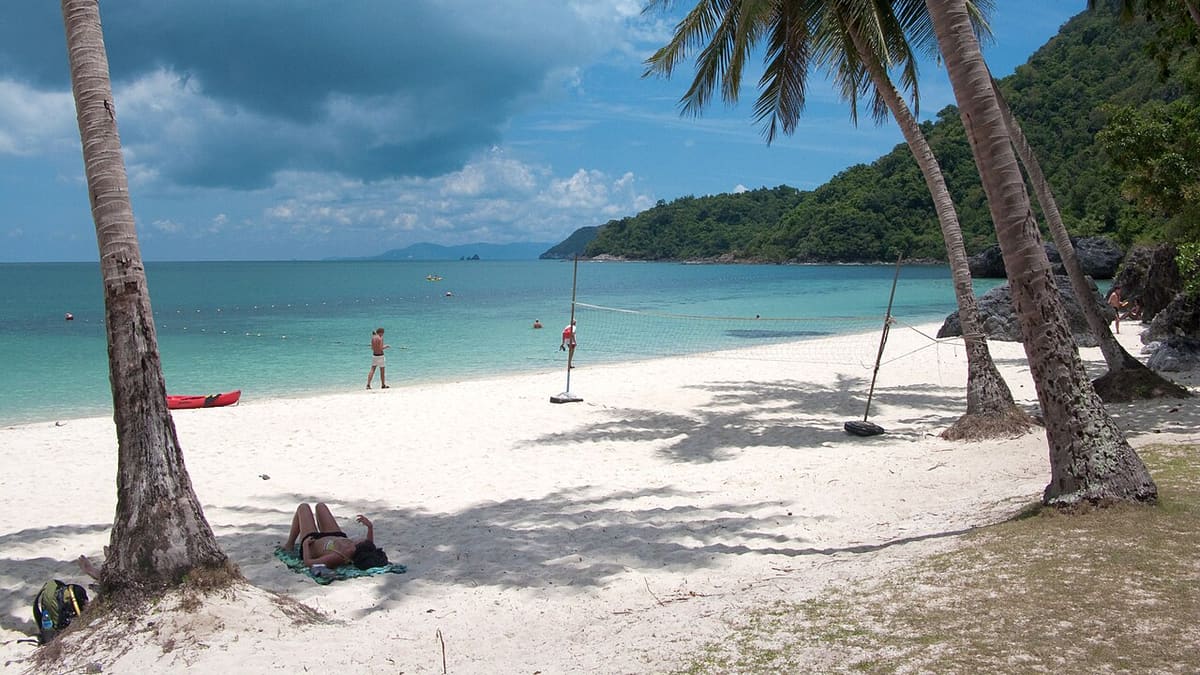
Koh Wua Talab is the park's administrative island: the DNP headquarters, a restaurant, a small shop, and the overnight bungalows and camping ground sit around Ao Kha bay. Most day tours anchor here for lunch and free time, which makes it the one place in the park that can feel genuinely busy around midday when several boats arrive together.
Ao Kha beach on Koh Wua Talab — park headquarters, lunch stop, and the start of the viewpoint climb. Photo: Vyacheslav Argenberg, CC BY 4.0
Kayaking and the caves
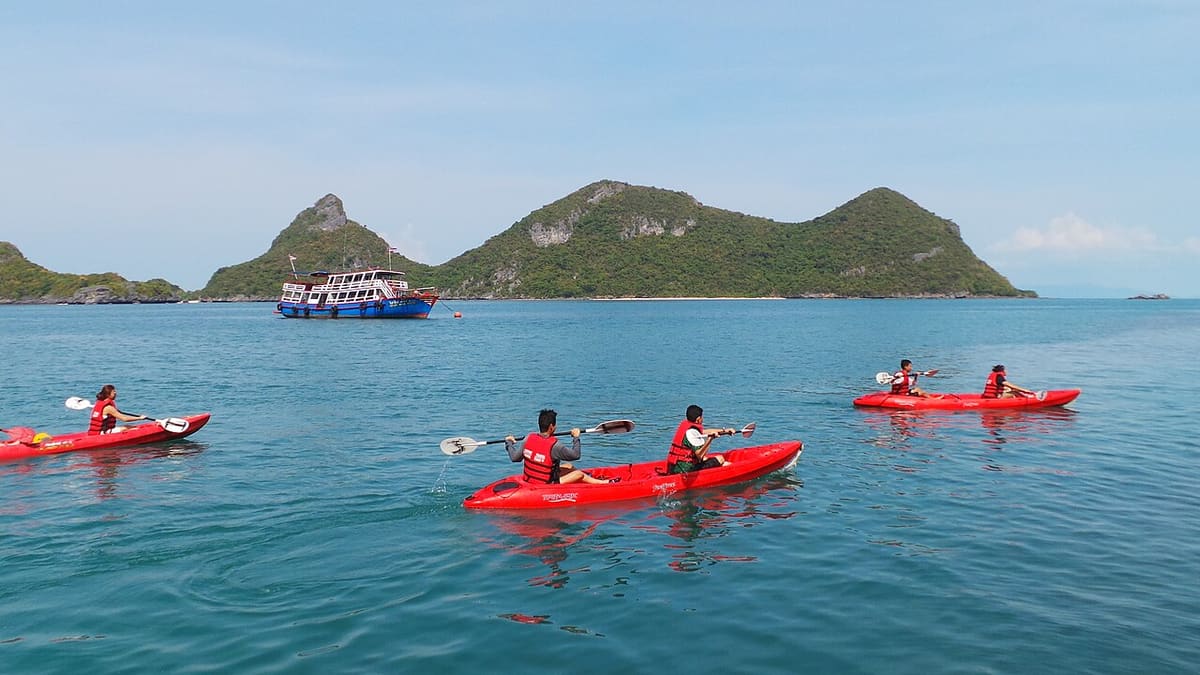
Several tours offer time to paddle a kayak along the limestone cliffs and into small coves, sometimes included in the price and sometimes as a paid extra — check the individual tour's inclusions rather than assuming. Koh Wua Talab also holds a stalactite cave, sometimes called the Bua Bok or Lotus Cave, that a number of tours include as a stop.
Paddling the cliffs by kayak — included on some tours, a paid extra on others.
Snorkelling — an honest expectation
Ang Thong is not a top-tier snorkelling destination, and it's worth saying so plainly. The water is shallow and its clarity depends heavily on weather and sediment; visibility figures reported by different sources swing anywhere from around 3 to 20 metres, and official reporting has previously noted that the reefs here see comparatively little recreational snorkelling because of that turbidity. If reef fish and clear water are your priority, Koh Tao and Koh Nang Yuan are the better-known destination for that. What you get here instead is scenery: limestone cliffs rising straight out of the water, a lagoon unlike anywhere else nearby, and a view from the top that most of the Gulf of Thailand can't match.
"The Beach" — a claim worth treating carefully
Ang Thong is frequently described in tourism material as an inspiration for Alex Garland's novel The Beach, and the emerald lagoon in particular gets cited for this often. That connection is not confirmed by the author or by any primary source we could find — one investigation has instead pointed to a different location, on Koh Phangan, as a possible inspiration for the story. What is documented without dispute is that the 2000 film adaptation was shot elsewhere entirely, principally at Maya Bay on Ko Phi Phi (with some scenes in Khao Yai) — not in Ang Thong. Treat the "Beach" association as a widely repeated but unverified piece of tourism folklore, not a fact.
Correct as of September 2026. Sources: DNP, tour operator descriptions, and the source list behind this page's research.
Calm seas make the day. In rough weather the park can close at short notice, and from 1 November to 15 December 2026 it is closed entirely. Photo: Vyacheslav Argenberg, CC BY 4.0
When the park is open — and when it isn't
One planned closure every year, plus the occasional short-notice one for weather.
2026 annual closure
1 Nov – 15 Dec
Pattern
Repeats yearly, redecided each year
Short-notice closures
Possible in rough seas
Calmer sea, typically
Outside Oct–Dec
The 2026 annual closure: 1 November – 15 December
Mu Ko Ang Thong closes officially every year for several weeks around the change of monsoon, giving the park a rest and avoiding the roughest stretch of sea on the Gulf side of Thailand. For 2026, the announced dates are 1 November to 15 December — confirmed by the national park authority. No tours run into the park during this window, and overnight stays aren't possible either. This kind of closure repeats in a broadly similar shape most years, but the exact dates are set fresh each year rather than being a fixed calendar rule, so don't assume next year's dates will match this one exactly — check current DNP or TAT announcements closer to your travel date, especially if you're planning a trip for late October or the first half of December.
Short-notice closures for weather
Outside the planned closure, the park authority can and does shut the park for individual days when wind and waves are too rough for safe boat travel — a closure of this kind was reported in early January 2026, for example. There isn't a public running list of these ad-hoc closures, so if you're travelling in a period of uncertain weather, the practical approach is to ask your tour operator on or just before the day rather than relying on anything you read in advance, including this page.
Best time to go
Broadly, the calmer, more reliable months fall between roughly February and September, with the rainy season from October through December bringing rougher seas and the highest chance of cancellations, on top of the confirmed November–December closure. Even within the better months, though, the Gulf of Thailand's weather is genuinely hard to forecast day to day — a calm week can still include one rough day, and vice versa. If your tour is cancelled because of sea conditions, that decision comes from the operator or the park authority for safety reasons, not from you, and cancellation terms don't apply against you in that case.
Correct as of September 2026. Sources: DNP, TAT (Tourism Authority of Thailand). Confirm exact 2026/27 closure dates directly with the park or your tour operator before booking travel around late October or early December.
Reef-safe sunscreen and no single-use plastic or foam: two of the park rules, with fines of up to 100,000 baht. Photo: Vyacheslav Argenberg, CC BY 4.0
Entry fee and park rules
What it costs to get in, what's banned, and what the fines look like.
The entry fee
In practice, current tour operators and travel sources consistently report a foreign-visitor entry fee of around 300 baht for adults and 150 baht for children, paid in cash on the day. That said, an older official DNP fee schedule lists Ang Thong at 200 baht for adults and 100 baht for children, and we could not find a single, unambiguous current DNP document confirming which figure applies specifically to this park as of September 2026. Most tour prices on this page list the park fee as a separate item, not included in the tour price — bring cash, and treat 300/150 baht as the realistic planning figure while accepting there's a genuine chance it's lower.
What's banned inside the park
Reef-damaging sunscreen ingredients. Sunscreens containing oxybenzone, octinoxate, 4-methylbenzylidene camphor (4-MBC) or butylparaben have been banned in Thailand's national marine parks since 2021. Reef-safe sunscreen is worth packing before you arrive, not sourcing on the day.
Styrofoam and single-use plastic. Banned from national parks since 2022.
Drones without prior permission. A general Thailand drone registration isn't enough on its own — flying inside the park needs separate permission from the park administration in advance.
Feeding wildlife. Applies to the langurs and any other animals you encounter — feeding them is prohibited.
Fines for these violations, along with general littering, can run up to 100,000 baht under Thailand's National Park Act. That's a ceiling figure rather than a typical on-the-spot fine, but it signals how seriously the rules are meant to be taken, particularly the sunscreen and plastic rules.
Staying overnight on Koh Wua Talab
The park authority rents out simple bungalows and tent space on Koh Wua Talab, bookable in principle through the official DNP reservation system. We're deliberately not quoting fixed prices here, since reported rates vary a fair amount between sources and the DNP's own booking pages don't display prices directly; the booking system has also been reported as unreliable at times. If an overnight stay interests you, check availability and current rates directly with DNP or ask a tour operator with local contacts, rather than trusting a number from a travel blog.
Correct as of September 2026. Sources: DNP, Ratchakitcha (Royal Gazette) notices on the sunscreen ban, DNP announcements on plastic and drone rules. Verify the current entry fee at the park gate or via your tour operator.
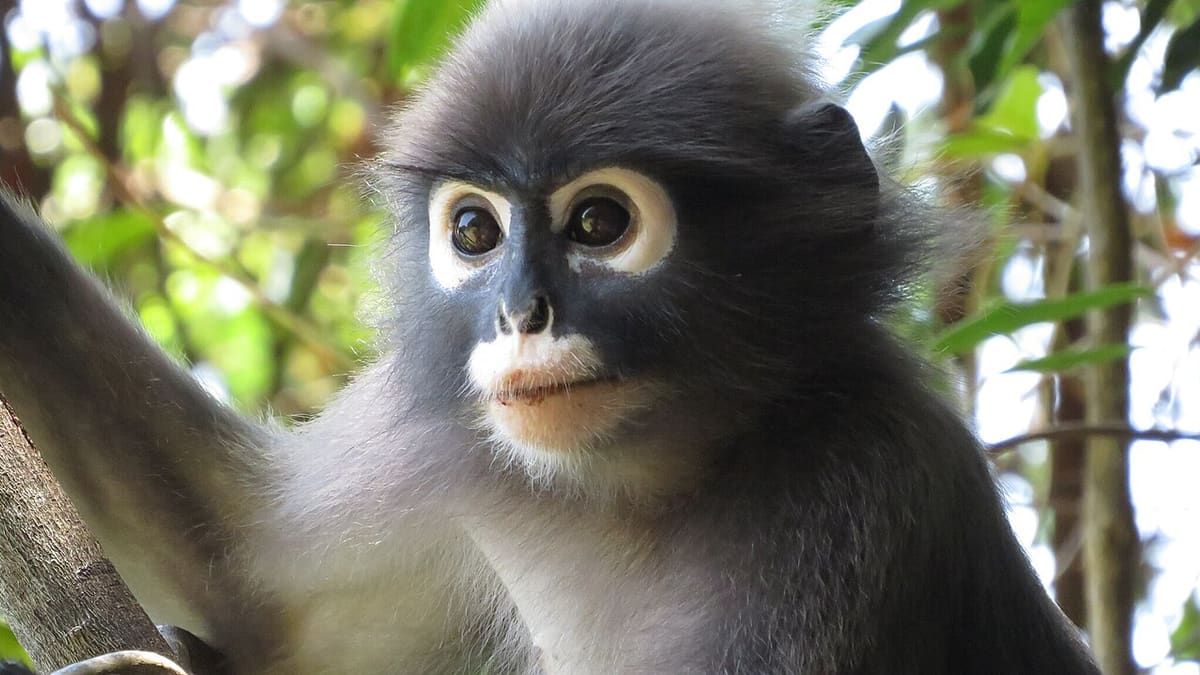
The dusky langur, one of the animals confirmed for the park.
Nature and wildlife in the park
What's well documented, and where the claims you'll read online get ahead of the evidence.
The landscape
The islands are limestone karst — the same geology behind the more famous formations of Phang Nga Bay further south — carved by the sea into steep cliffs, hidden coves and at least one notable stalactite cave on Koh Wua Talab. It's this landscape, more than any single animal or reef, that gives the park its character.
What's confirmed
Dusky langurs (spectacled langurs), a leaf-eating monkey with pale rings around the eyes, are well documented in the park and one of the more reliable wildlife sightings on a visit. The Oriental Pied Hornbill is also confirmed present. Beyond these two, official documentation gets thinner.
What's reported but not confirmed
Tourism material and some tour descriptions also mention monitor lizards, long-tailed macaques, white-bellied sea eagles, reef sharks and sea turtles in or around the park. We could not find a current, official park source that confirms all of these for Ang Thong specifically — some appear on regional biodiversity lists that cover a wider area than just this park. Treat sightings of anything beyond the langurs and hornbills as a pleasant surprise rather than something to expect.
Coral health
The Gulf of Thailand experienced a severe, officially documented coral bleaching event in 2024, with Thailand's marine authority (DMCR) reporting the large majority of monitored reefs affected gulf-wide. We couldn't find a reliable, Ang Thong-specific assessment of current reef condition for 2025/2026 — the golf-wide picture is well documented, the park-specific one isn't. This is a further reason snorkelling expectations here should stay modest rather than assuming pre-2024 conditions.
Correct as of September 2026. Sources: DNP, DMCR (Department of Marine and Coastal Resources) coral bleaching reporting, and regional biodiversity references.
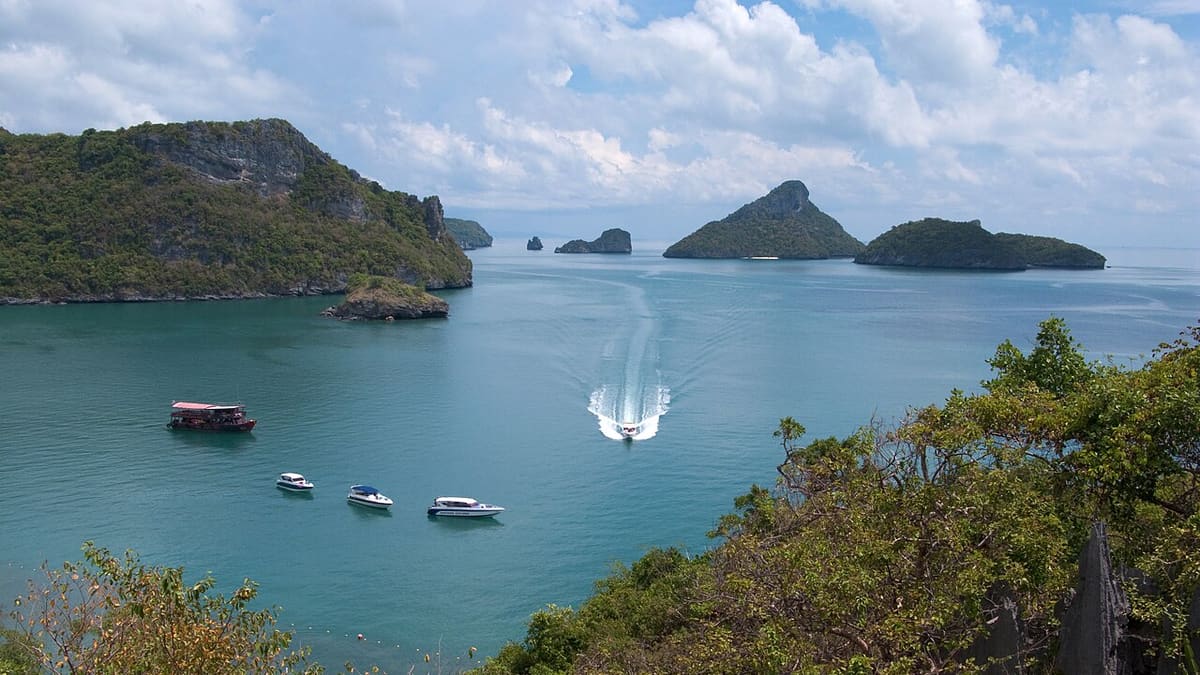
Two piers, two boat types — and no way in except by water. Photo: Vyacheslav Argenberg, CC BY 4.0
Getting there and what a day looks like
Piers, crossing times, seasickness, and what to pack.
Departure piers
Big boat tours typically depart from Nathon, on Koh Samui's west coast — the closer crossing to the park. Speedboat tours mostly depart from Bangrak in the north, or occasionally Thong Krut in the south for some private tours. Bophut and Maenam turn up in some marketing as pickup points, but these are best understood as hotel-area pickup zones feeding into a minibus transfer, not independent departure piers in their own right — the boat itself still leaves from Nathon, Bangrak or Thong Krut.
Speedboat vs big boat
Speedboats cover the roughly 30–35 kilometres to the park faster, in the region of 45 minutes to just over an hour depending on the exact route and sea conditions, though some tour schedules on this page allow closer to 90 minutes when the itinerary makes several stops along the way. Big boats take longer, typically around 1.5 to 2 hours each way, but sit steadier in a swell and give you more time to relax on a spacious deck rather than bracing against chop. If you're prone to seasickness, the big boat is the more forgiving choice; take any motion sickness medication before departure, not once you're already on board.
A typical day
Expect an early hotel pickup, usually between 7:00 and 8:15, followed by the crossing to the park with a light breakfast served on the way on most tours. Around midday comes lunch, either on board or on one of the islands, and the afternoon covers the viewpoint climb, the lagoon walk, and free time to swim or snorkel, depending on the specific tour's itinerary. Return crossings generally land you back on Koh Samui in the late afternoon or early evening, with drop-off at your hotel following shortly after.
What to pack
Sturdy, closed shoes for the viewpoint climb — flip-flops make the steep, rocky sections harder than they need to be
Reef-safe sunscreen (oxybenzone, octinoxate, 4-MBC and butylparaben are banned in the park), a hat and plenty of water
Cash for the park entrance fee
A waterproof pouch for your phone if you're kayaking or snorkelling
Seasickness tablets, taken before you board if you're at all prone to it
Correct as of September 2026. Sources: tour operator itineraries, DNP.
Worth it on a cruise call — but only with a real time buffer before the last tender. Photo: Vyacheslav Argenberg, CC BY 4.0
Ang Thong on a Koh Samui cruise call
Tight but possible — if you build in enough buffer before the ship sails.
Tendering at Nathon
Koh Samui has no deep-water cruise berth, so ships anchor offshore and passengers come in by tender to Nathon pier — the same pier most big-boat Ang Thong tours use as their own departure point. That double dependency on tenders (once to get ashore, once again to get back before the ship sails) is the main reason an Ang Thong day needs careful planning rather than a same-day decision.
Is it realistic in a single port day?
The crossing itself takes roughly 45 to 60 minutes by speedboat, and a full Ang Thong programme typically runs 7 to 9 hours door to door. Whether that fits your specific call depends entirely on your ship's actual time in port, which varies considerably by cruise line and itinerary — there's no universal number to plan against. As a rule of thumb: it's realistic only with an early tender, a full-day programme, and a genuine buffer of 90 to 120 minutes built in before your ship's last tender back, on top of whatever the tour itself allows. If your ship's port time is short, or you're not confident about tender queues on the day, a shorter excursion elsewhere on Koh Samui is the safer choice.
An important honesty point: the return guarantee
On the group cruise excursions to Ang Thong listed here, the tour is run by a partner operator, and the usual "back to your ship on time" guarantee that applies to most other Koh Samui shore excursions does not apply in the same way to this one. The operator's stated priority is still to get you back on schedule, but it's worth knowing this excursion works differently before you book it against a tight port call. If a guaranteed on-time return matters to you more than anything else, a private Ang Thong tour with an explicit return commitment, or a shorter excursion elsewhere, is the more conservative choice.
Group or private
Group cruise tours to Ang Thong follow a fixed itinerary and schedule shared with other passengers, which keeps the price down but leaves less room to adjust if your tender is delayed. Private tours cost more per person but let the operator adjust pace and timing around your specific ship's schedule, which matters more here than on almost any other Koh Samui excursion given how unforgiving a missed tender can be.
The 2026 closure and cruise season
The park's official closure from 1 November to 15 December 2026 falls right at the start of the winter cruise season in the Gulf of Thailand, so any early winter port call should be checked against the closure dates before booking an Ang Thong excursion — this is one of the more common ways cruise guests end up disappointed by an unavailable tour.
Correct as of September 2026. Sources: TAT, tour operator itineraries and terms. Confirm your ship's actual port hours with your cruise line, not with a general estimate.
The questions that come up most before a first visit. Photo: Ditsakul, CC BY-SA 3.0
Frequently asked questions
Straight answers, including where the honest answer is "it depends" or "nobody official has confirmed that."
Is Ang Thong worth visiting?
For scenery and a day on the water, yes — the limestone islands, the lagoon and the viewpoint are genuinely striking. If your main goal is snorkelling with clear water and abundant coral, temper your expectations or consider Koh Tao instead; Ang Thong's water is shallow and its visibility depends heavily on conditions.
How do you get to Ang Thong National Park?
Only by boat — there's no bridge or scheduled ferry. Almost everyone arrives on an organised tour from Koh Samui, departing from Nathon (big boats) or Bangrak (speedboats), with hotel pickup included on most tours.
Can you swim in the Emerald Lake?
No. Swimming in Talay Nai on Koh Mae Ko is strictly prohibited — you view it from a platform above, not from the water.
What does entry to the park cost?
Current tour operators and travel sources consistently report around 300 baht for adults and 150 baht for children, paid in cash on the day. An older official fee table lists lower figures, so treat 300/150 baht as the realistic planning number and bring cash regardless.
When is Ang Thong National Park closed in 2026?
Officially from 1 November to 15 December 2026, confirmed by the national park authority. The park can also close at short notice on individual days in rough weather, at any time of year.
Can I stay overnight in the park?
Yes, in simple bungalows or tents on Koh Wua Talab, run by the park authority. Book through the official DNP reservation system or via a local operator; we're not quoting fixed prices here since reported rates vary and the system itself has had reliability issues.
Is Ang Thong doable as a cruise ship excursion?
Often, yes, but it's genuinely tight. You need an early tender ashore and a real buffer — 90 to 120 minutes — before your ship's last tender back. Check your ship's actual port hours before booking, and note that the group cruise excursion here doesn't carry the usual on-time return guarantee.
Which tour type should I book?
Big boat if you're prone to seasickness or want a relaxed pace; speedboat for more time on the islands themselves; sailing boat for a slower, scenic crossing on its fixed weekly days; private if you want full control of the schedule; the cruise-guest tours if you're arriving by ship. The comparison on this page's tour list breaks down the practical difference between each.
Is snorkelling good at Ang Thong?
It's fine, not exceptional. Visibility is inconsistent and depends on weather and sediment; some sources report it as low as 3 metres on a bad day and up to around 20 on a good one. If snorkelling quality is your top priority, Koh Tao or Koh Nang Yuan are the better-regarded choice.
Is Ang Thong really the inspiration for "The Beach"?
It's a widely repeated claim in tourism marketing, but not one confirmed by the author or any primary source we found — one investigation instead points to a different island, Koh Phangan, as a possible inspiration. What's certain is that the film adaptation was shot elsewhere, mainly at Maya Bay on Ko Phi Phi, not in Ang Thong.